
Summary of what is included...
You already own the herbicide. You followed the directions on the bottle.
Your Bush Honeysuckle is back. Your food plot failed. Your Tree of Heaven now has fifteen sprouts where there was one.
This isn't bad luck. It's a precision problem — and it's fixable.
What serious landowners and professional foresters are saying:
"This is a wonderful resource. I am a licensed forester in WV and Maryland leaving my job as an NRCS forester to start my own woodland management business. This resource will help me stay on track. I seen it was applicable to WV so I decided to buy it."
— Dylan Kesner, Licensed Forester
Appalachian Woodland & Wildlife Management, LLC — West Virginia & Maryland
The Woodland Herbicide Guide is a professional reference written at state extension publication standard by a Master Forester and Certified Pesticide Applicator. This is the technical manual serious landowners have been asking for — the kind of guidance that used to require hiring a consulting forester to access.
What's inside:
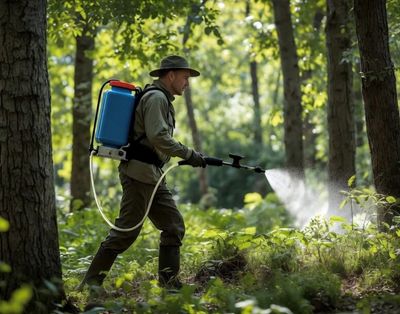
✔ 6 Application Methods — Basal Bark, Cut Stump, Foliar Spray, Girdle & Spray, Hack & Squirt, and Stem Injection. Exact steps, mixing tables, and seasonal windows for every method.
✔ 10 Invasive Plant Profiles — Autumn Olive, Bush Honeysuckle, Tree of Heaven, Garlic Mustard, Multiflora Rose, Callery Pear, Oriental Bittersweet, Japanese Knotweed, Canada Thistle, and Common Buckthorn. Full multi-year eradication sequences for each.
✔ Month-by-Month Treatment Calendar — What to treat, with what chemical, in what order, every single month of the year — calibrated across the full Eastern Hardwood Belt from Minnesota to Tennessee.
✔ Complete Food Plot Herbicide Management — Glyphosate burndown protocols, pre- and post-emergent strategy, selective herbicide compatibility for clover and brassicas, and the Triclopyr soil residual caution that destroys food plots every spring.
✔ Equipment & Calibration — Sprayer selection, nozzle guide, and the 8-minute calibration method that fixes the inaccurate spray rates behind most treatment failures.
✔ 6 Appendices — Mixing calculator, full glossary, 16-state regulatory contact table, and a laminate-ready quick-reference matrix.
Why landowners who've tried everything still fail:
Most herbicide failures come down to four things — wrong formulation, wrong carrier, wrong season, or wrong method for the target species.
The bottle tells you what to buy. It doesn't tell you:
- That using Triclopyr Amine instead of Triclopyr Ester in a winter basal bark application produces zero kill
- That the September–October foliar window delivers more root kill on Bush Honeysuckle than two full summer applications combined
- That cutting Tree of Heaven without treating the stump in 60 seconds turns one stem into fifteen
- That Triclopyr soil residual from fall brush treatment will silently kill your clover food plot the following spring before a single seed germinates
This guide does.
Covers 16 states across the Eastern Hardwood Belt:
Ohio · Indiana · Illinois · Iowa · Michigan · Wisconsin · Minnesota · Missouri · Tennessee · Kentucky · West Virginia · Arkansas · Kansas · Nebraska · North Dakota · South Dakota
Northern-tier states: use the later end of treatment windows. Southern-tier states (TN, KY, AR, MO): use the earlier end — typically 2–4 weeks ahead.
This guide is for you if:
- You manage private woodland and are losing ground to invasive shrubs and trees
- You put in food plots and keep fighting weed pressure that outcompetes your seed
- You've spent money on herbicide treatments that didn't work and want to know why
- You want to manage your land the way a professional forester would — without hiring one
This guide is not:
A beginner's overview or a generic "how to use herbicide" pamphlet. It is a technical field reference with exact mixing ratios, application mechanics, chemical carrier science, and multi-year management sequences for the ten most damaging invasive species in the Eastern Hardwood Belt.